


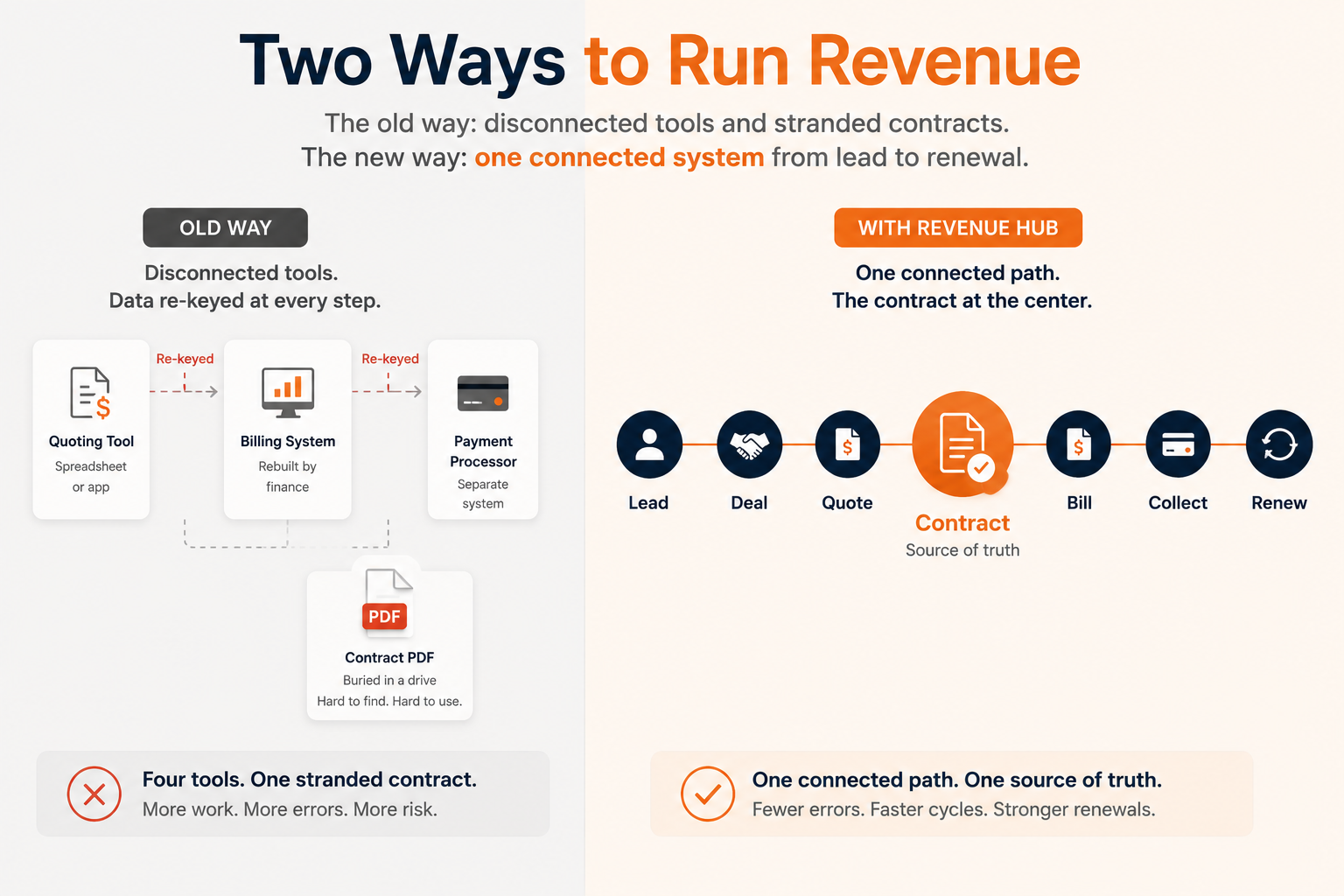
Today HubSpot launched Revenue Hub, and it solves a problem most B2B teams stopped noticing because they got used to living with it.
Your quote lives in one tool. Your billing runs in another. Payments sit somewhere else. And the contract, the actual record of what the customer agreed to buy, ends up as a signed PDF buried in a shared drive. Every gap between those systems is a place where deals stall, numbers drift, and someone ends up rebuilding data by hand.
Revenue Hub closes those gaps. CPQ, billing, and payments now run as one connected system inside HubSpot, with the contract as the single source of truth.
Here is what that actually means for your revenue operation.
The problem was never the quote. It was everything after it.
Most companies have invested in quoting at some point. The friction shows up later. A rep closes a deal, and now finance has to recreate the terms to bill against them. A customer wants to add seats mid-term, and someone rebuilds the quote from scratch. Renewal season arrives, and RevOps is stitching together old deals, PDFs, and calendar reminders to figure out what each account actually has.
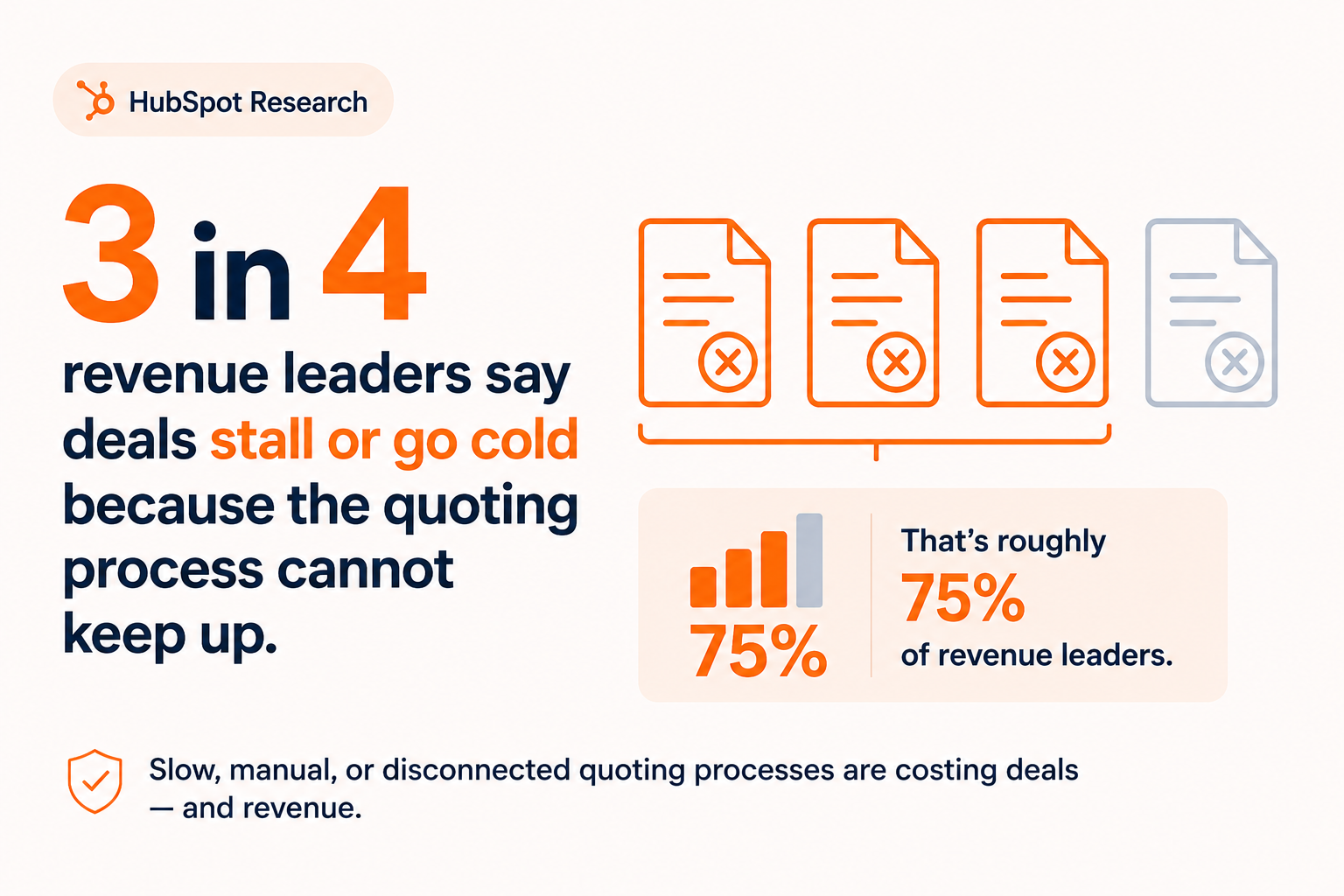
The cost is measurable. HubSpot's own research found that roughly three in four revenue leaders say deals stall or go cold because the quoting process cannot keep up.
None of that is a quoting problem. It is a disconnection problem. The data that should flow from sale to bill to renewal gets re-keyed at every step, and every re-key is a chance to get it wrong.
What Revenue Hub is
Revenue Hub unifies three things that have always been treated as separate: configure-price-quote (CPQ), billing, and payments. They now share one foundation inside HubSpot.
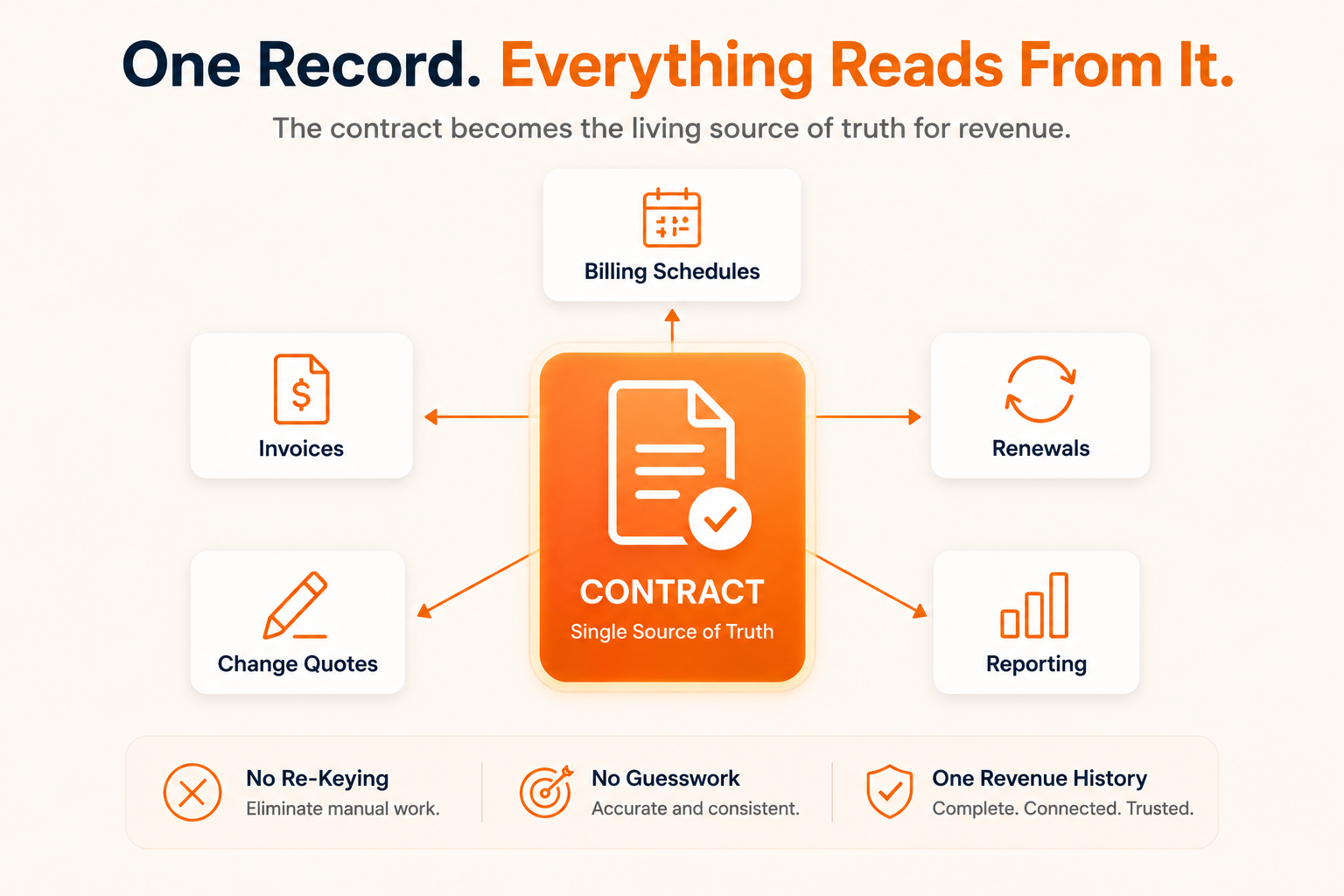
The center of it is the contract. When a quote is signed, it becomes a contract record: what was purchased, at what price, on what terms, with what start and end dates, and how it changes over time. That record powers everything downstream. Billing schedules, invoices, and renewals all read from the same source instead of being manually reconstructed.
If you knew this product as Commerce Hub, this is what changed. Payments arrived in 2021, billing in 2023, AI-powered quoting in 2025. Revenue Hub is the moment those pieces stop being separate features and become one system, tied together by the contract. The rename is not cosmetic. Commerce described transactions. Revenue describes the whole lifecycle.
It is built for software and services companies with recurring or contract-based revenue, roughly 20 to 500 employees. If that is you, the rest of this matters.
Think of it the way a well-run restaurant works. The order, the check, and the card reader are one flow. Nobody walks the ticket down the street to a different shop to get the customer billed. Revenue Hub brings that same continuity to B2B revenue.
The contract changes the math on renewals and expansion
This is the part worth slowing down on, because it is where the structural advantage lives.
When the contract is the living record, mid-term changes stop being rebuilds. A change quote inherits the existing terms, you adjust quantities or swap products, and proration calculates automatically. The customer sees only what changed, not the entire original quote. The contract updates instead of spawning a new one.
Renewals work the same way. The renewal quote generates from the contract itself, with uplift rules and term changes applied, and the account keeps one continuous revenue history. No new deal-creation exercise. No reverse-engineering what the customer bought eighteen months ago.
This matters more than it sounds. HubSpot found that 76% of teams miss renewals because revenue data lives somewhere other than the customer record. When the contract sits in the CRM next to the deal and the company, that failure mode goes away.
For any business that grows through expansion and retention, which is most companies worth their margin, this is the difference between renewals being a fire drill and renewals being a workflow.
Where this gets interesting: every agent works from the same revenue truth
Most tools bolt AI on top of a system that was never built to feed it. Revenue Hub does the opposite. Because revenue context now lives where your customer data lives, AI can work across the entire quote-to-cash path.
Reps build quotes from a plain-language prompt instead of a spreadsheet. A customer-facing agent answers billing questions and sends payment links without pulling in a rep. A revenue agent follows up on overdue invoices on its own, using account value and age to decide what to chase first. Your team handles the exceptions instead of every follow-up.
The point is not that AI is involved. The point is that the AI is working from the real revenue record, not a stale copy of it.
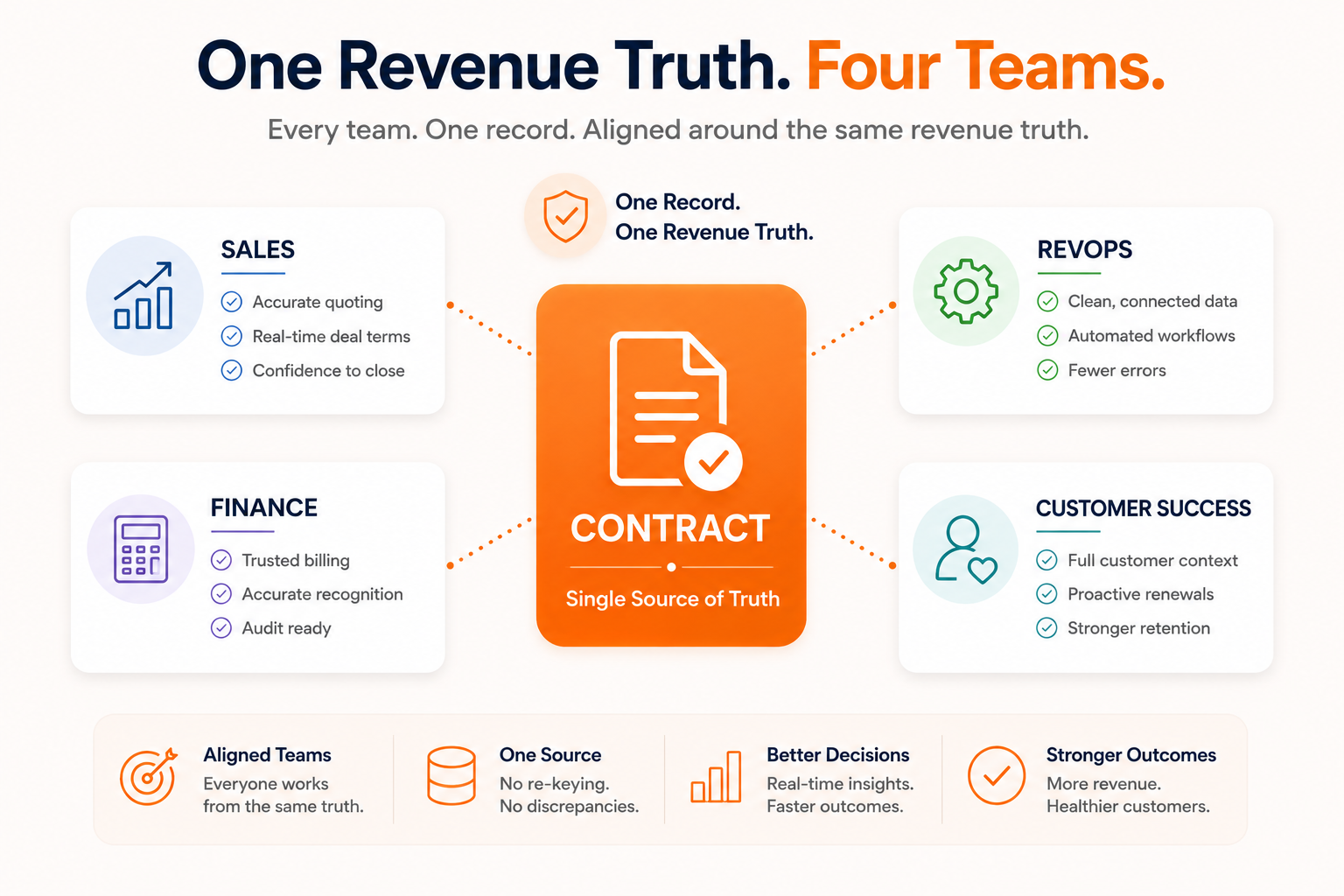
What it means for each seat at the table
The value lands differently depending on where you sit.
Sales reps build accurate quotes in minutes and move on. The contract is created automatically when the deal closes, so there is no second system to update.
RevOps finally works from structured data instead of reverse-engineering PDFs. Setup flows downstream, so the work you do once propagates across the entire lifecycle.
Sales and finance leaders get clean revenue attribution and real visibility into what has been sold, what it is worth, and what is collected versus outstanding. That gap is real today. Only about a third of finance and sales teams close the month from the same numbers. One source of truth closes it.
Customer success walks into renewal and expansion conversations knowing exactly what the account has and how it has changed.
Visibility is the thread that connects all of them. Everyone is finally looking at the same revenue truth.
You do not have to adopt all of it at once
One of the smarter design choices here is that the pieces work independently. A business that just needs to take payments can run payments alone. A company that invoices against agreed terms without complex configuration can run billing on its own. And when you connect all three, the system runs end to end.
That modularity matters because it means you can start where your actual pain is, then scale into the full quote-to-cash system as you are ready. You are not buying a monolith. You are building a foundation.
Why this is bigger than a feature release
Governance is built in, not bolted on. You can lock branding, sections, and legal language into quote templates so every quote ships compliant. You can set discount limits, block incompatible products, and route approvals automatically based on deal conditions. You control which roles can see and edit sensitive fields like price, cost, and margin. The rules live in the system, and reps work within them.
That is what separates a quoting tool from a revenue system. A tool speeds up one task. A revenue system protects your commercial strategy while it runs.
What to do with this
If your quoting, billing, and payments are living in different systems right now, today is a good day to map what that disconnection is actually costing you. The manual rework, the renewal scrambles, the finance-versus-sales arguments about what a customer really bought. That is the bill you have been quietly paying.
Revenue Hub gives you a way to stop paying it. The setup is where the leverage is, though. A product library and pricing architecture built right, governance configured to your commercial strategy, and clean automation are what turn this from a new tool into a genuine operating advantage. The build sequence is not optional either: product library first, then quote templates, then guardrails, then optimization and reporting. Foundation errors compound, so the order matters.
That work is also what separates a system that runs from a system that just exists. Portals built and managed with a partner are already driving meaningfully more payment volume and revenue than portals stood up without one. The difference is not the software. It is how it gets built.
That is the work we do. If you want to talk through what a Revenue Hub implementation looks like for your business, let's set up a time.
Sales Surge Solutions is a HubSpot Platinum Solutions Partner specializing in full-service RevOps and HubSpot implementations across Sales, Marketing, Service, and Operations Hub.
.jpg?width=352&name=process-mapping-scene-illustration-2.png%20(inferred%3B%20actual%20file%20name%20may%20vary%20based%20on%20generation%20or%20download).jpg)
Leave a Comment